Visual thinking methods
Concept Map vs Mind Map: Key Differences and When to Use Each
Both methods organize ideas visually, but they solve different problems. A mind map expands outward from one central topic. A concept map explains a network of concepts and makes the meaning of their relationships more explicit.
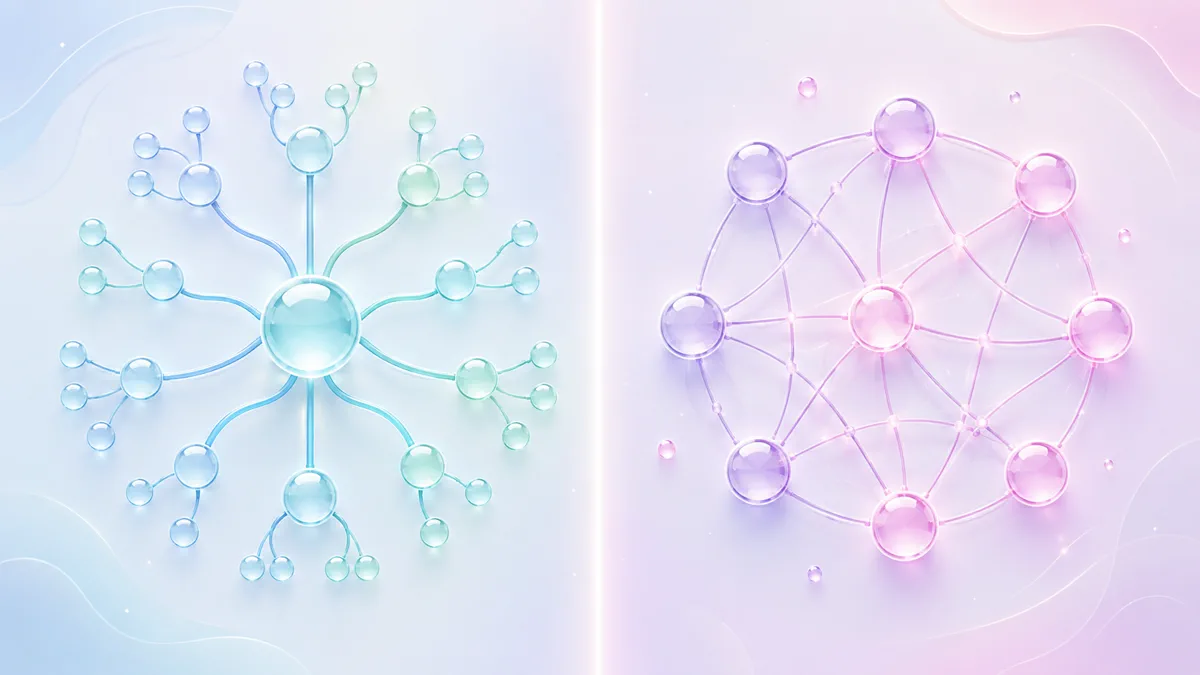
What is the difference between a concept map and a mind map?
A mind map starts with one central topic and grows through branches from broad categories to details. A concept map usually starts with a focus question, arranges several concepts in a hierarchy or network, and uses connections—often with linking words—to explain relationships such as “causes,” “requires” or “is part of.” Choose a mind map to explore and organize one topic; choose a concept map to explain how multiple concepts relate.
Mind map and concept map definitions
What is a mind map?
A mind map is a radial visual structure. The center names one subject, question or goal. Main branches divide it into major categories, and child branches add facts, tasks, examples or questions. It is well suited to brainstorming, study notes, project planning, meeting notes and personal organization.
The map normally moves from one center toward increasing detail. Branches can be rearranged as your understanding changes, which makes mind mapping useful when you are still exploring a subject. The step-by-step mind map guide explains this process in detail.
What is a concept map?
A concept map is a visual explanation of knowledge. It places concepts in boxes, bubbles or other nodes and connects them to show meaningful relationships. Many formal concept maps use short linking phrases so two connected concepts form a readable proposition: for example, “Plants — use — sunlight” or “Evaporation — is driven by — heat.”
Concept maps often begin with a focus question. Broader concepts usually appear above or before more specific ones, but cross-links can connect different parts of the structure. The goal is not merely to collect related ideas; it is to make the relationships between those ideas understandable and testable.
Six key differences
1. Starting point
One center vs a focus question
A mind map usually starts with one central topic such as “Renewable energy.” A concept map often begins by asking something specific, such as “How do renewable energy systems supply electricity?” The focus question determines which concepts and relationships belong.
2. Shape
Radial branches vs a network
A mind map radiates outward from the center and typically resembles a tree. A concept map can contain several pathways and cross-links, creating a network rather than a single set of parent-and-child branches.
3. Connections
Grouping vs stated relationships
In a mind map, a connection usually means that a child belongs beneath or expands on its parent. In a concept map, the connection itself carries meaning. Linking phrases can state that one concept causes, includes, depends on or contrasts with another.
4. Hierarchy
Center-out detail vs general-to-specific knowledge
Mind maps build detail outward from the center. Concept maps often place broad concepts first and more specific concepts below them, while allowing cross-links between different areas of the hierarchy.
5. Main purpose
Explore a topic vs explain a system
Mind maps are strong for generating, grouping and recalling ideas around one subject. Concept maps are strong for showing how parts of a system interact and for revealing whether someone understands those relationships.
6. Reading path
Scan from the center vs follow propositions
A reader scans a mind map from the center into the branch that interests them. A concept map invites the reader to follow connected statements across the network, sometimes along several valid paths.
Concept map vs mind map at a glance
- Mind map center: one topic, problem, question or goal.
- Concept map starting point: commonly a focus question and a set of relevant concepts.
- Mind map connections: branches usually show category and detail.
- Concept map connections: lines may include words that define the relationship.
- Mind map flow: primarily radial and tree-like.
- Concept map flow: hierarchical or networked, with cross-links between areas.
- Mind map strengths: brainstorming, planning, summaries, note-taking and personal organization.
- Concept map strengths: explaining systems, assessing knowledge, comparing models and identifying misconceptions.
These are useful conventions, not rigid laws. Real working diagrams often borrow from both. The important question is whether the structure helps the intended reader think, learn or decide.
The same topic shown two ways
Consider a student learning the water cycle. A mind map can collect and organize the main areas of the subject:
The water cycle
├── Stages
│   ├── Evaporation
│   ├── Condensation
│   └── Precipitation
├── Energy
│   └── Sunlight
├── Storage
│   ├── Oceans
│   └── Groundwater
├── Human impact
└── Review questions
The structure is easy to expand and useful as a chapter overview. A concept map would focus more directly on the relationships:
Sunlight
└── provides energy for → Evaporation
    └── changes liquid water into → Water vapour
        └── cools and forms → Clouds
            └── release → Precipitation
                └── replenishes → Rivers and groundwater

Plants ── release water through → Transpiration
Oceans ── store most of → Earth's surface water
The text version simplifies the visual layout, but it shows the essential difference: the mind map groups what belongs to the topic, while the concept map states how one concept relates to another.
Which one should you use?
Choose a mind map when you need to:
- brainstorm several directions from one prompt;
- summarize a chapter, meeting or project;
- break a goal into categories and actions;
- capture ideas quickly before the final structure is known;
- create a scannable personal or team overview.
Choose a concept map when you need to:
- explain how a process or system works;
- state causal, conditional or part-to-whole relationships;
- compare an expert model with a learner’s current understanding;
- connect concepts that belong to different parts of a hierarchy;
- find missing links, contradictions or misconceptions.
Use a hybrid when both views help
You might begin with a mind map to gather the important concepts, then add cross-links or create a separate concept map to explain the strongest relationships. This is often more efficient than forcing a formal network while you are still discovering what belongs in the subject.
How to build a mind map
Choose one clear center
Use the subject, question or result the map should help you explore. Split unrelated goals into separate maps.
Add broad first branches
Create categories that cover different parts of the center without overlapping unnecessarily. Three to seven is a useful starting range, not a rule.
Develop each pathway
Add examples, facts, questions and actions as child branches. YaviMind supports unlimited branch levels, so detail can grow without flattening the hierarchy.
Review and reorganize
Move misplaced ideas, merge duplicates and rename vague labels. A useful map reflects your current understanding rather than preserving the order in which ideas first appeared.
For more complete structures, browse mind map examples for study and work. When you are ready to build, start a free map in your browser.
How to plan a concept map
- Write a focus question. Define what the finished map should explain.
- List the necessary concepts. Include only ideas that help answer the question.
- Order them. Place broad concepts before or above more specific ones.
- Connect related concepts. Look beyond immediate parent-and-child relationships.
- Add linking phrases. Read each connection as a short, meaningful statement.
- Test the logic. Remove vague links, correct contradictions and add missing concepts.
YaviMind is designed primarily as a bubble-based mind map maker. You can connect bubbles and arrange ideas visually, so it can support informal concept-map-style thinking. It does not provide dedicated labels on connector lines. If a linking phrase is important, place it in a separate bubble between concepts, or use a specialist concept-mapping tool when formal labelled propositions are required.
Using either method with a group
Collaboration changes the role of the map. Instead of one person presenting a finished structure, participants can reveal how they currently understand the topic. Differences become useful discussion points: two people may place the same idea under different branches, or disagree about whether one concept causes another.
YaviMind lets you share a map by email and edit the same map with other people. Changes save automatically to cloud storage, and the workspace runs in modern desktop and mobile browsers. For a group exercise, agree on the focus, let participants add or connect ideas, then review each major relationship together. A shared map records the group’s conclusion, but the conversation used to reach it is where much of the learning happens.
Common mistakes
Calling every connected diagram a mind map
A diagram with several starting points, cross-links and labelled relationships may function more like a concept map. Naming the method accurately helps people understand how to read it.
Adding arrows without explaining them
In a concept map, a line that could mean “causes,” “contains” or “depends on” is ambiguous. Add a linking phrase or restructure the connection so the intended relationship is clear.
Forcing cross-links into every mind map
A few meaningful cross-links can reveal relationships, but too many can make a radial map difficult to scan. When the network becomes the main message, a concept map may be the better format.
Choosing by appearance alone
Curved branches or rectangular nodes do not define the method. Decide based on the job: organizing one topic, or explaining relationships among concepts.
Frequently asked questions
Is a concept map the same as a mind map?
No. Both are visual thinking tools, but a mind map typically grows radially from one center, while a concept map represents a network of concepts and often labels the relationships between them.
Which is better for studying?
Use a mind map to summarize a chapter, organize revision topics or brainstorm what you know. Use a concept map to explain a process, test your understanding of relationships or identify a misconception. Many students benefit from using both at different stages.
Can a mind map have cross-links?
Yes. A cross-link can show a useful relationship between branches. If cross-links and their precise meanings become the main point of the diagram, the result is moving toward a concept map.
Which method is easier for beginners?
A simple mind map is often faster to begin because it needs one center and a few categories. A good concept map usually requires more deliberate decisions about hierarchy and the meaning of each connection.
Can YaviMind create concept maps?
YaviMind is primarily a mind map maker. Its connected bubbles can support informal concept-map-style layouts, but connectors do not have dedicated text labels. Use separate linking-phrase bubbles when that is sufficient, or a specialized tool for formal concept mapping.